


งานสัมมนาหัวข้อ "Valuation of Military Spending with the Existence of Rising Threat from North Korea: Evidence from an Intertemporal Demand Model of Japan and South Korea"
27 สิงหาคม 2569
อ่าน : 176
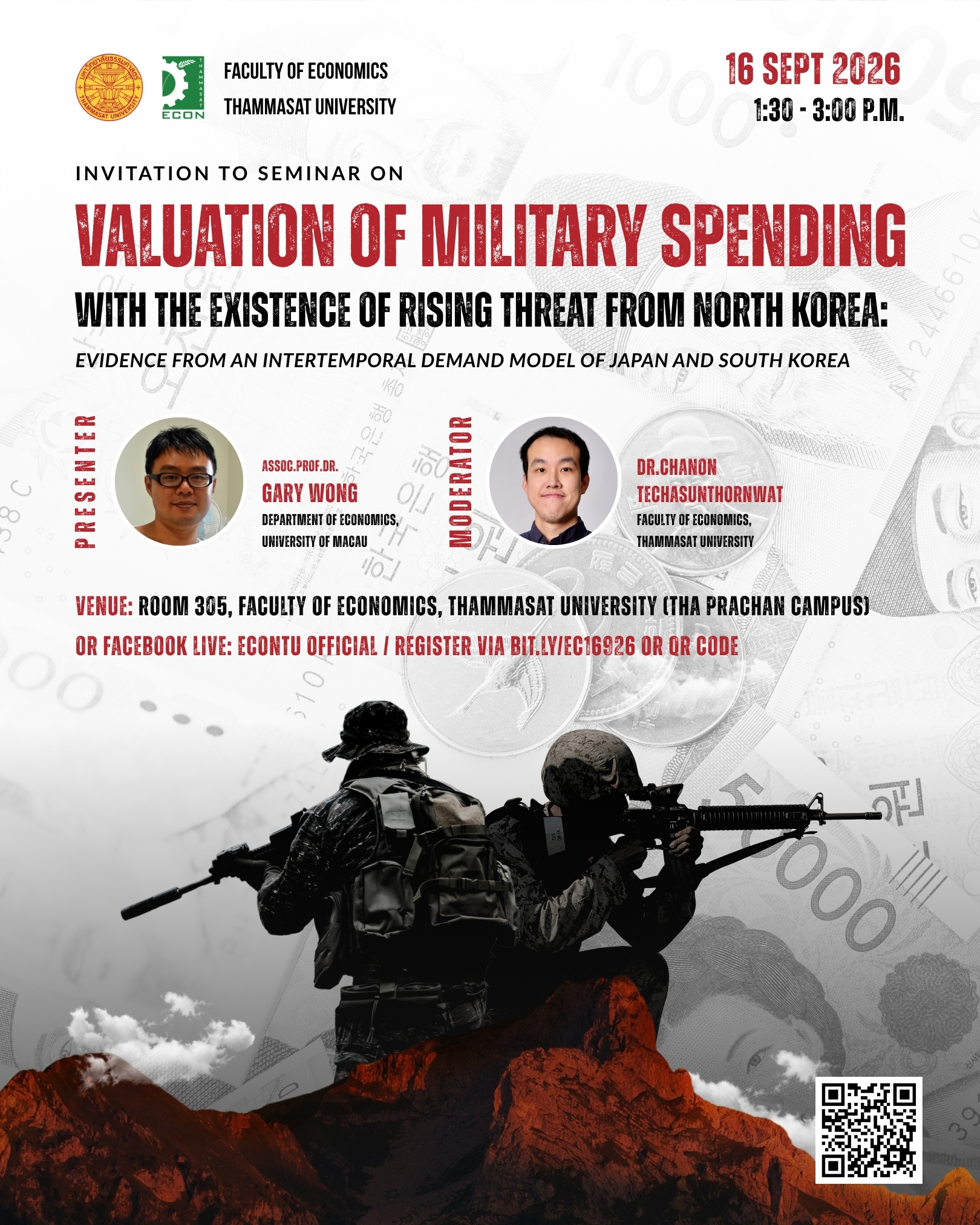
ขอเชิญผู้ที่สนใจรับชมการสัมมนาหัวข้อ "Valuation of Military Spending with the Existence of Rising Threat from North Korea: Evidence from an Intertemporal Demand Model of Japan and South Korea"
วันที่ 16 กันยายน 2569 เวลา 13:30 - 15:00 น. ณ ห้อง 305 คณะเศรษฐศาสตร์ มหาวิทยาลัยธรรมศาสตร์ ท่าพระจันทร์ หรือรับชมผ่าน Facebook live: EconTU Official
ลงทะเบียนเข้าร่วมงานได้ที่: https://bit.ly/EC16926 หรือผ่าน QR Code
นำเสนอโดย Assoc.Prof.Dr.Gary Wong - Department of Economics, University of Macau
ดำเนินรายการโดย อ.ดร.ชานนทร์ เตชะสุนทรวัฒน์ - คณะเศรษฐศาสตร์ มหาวิทยาลัยธรรมศาสตร์
หมายเหตุ: การสัมมนาบรรยายเป็นภาษาอังกฤษ
Abstract: North Korea’s security threat to Northeast Asia, manifested in its hastening nuclear weapons development and missile provocations, has prompted South Korea and Japan to significantly raise their levels of defense spending. This study presents a novel model for measuring the shadow price of national defense and welfare consequences of security threat within an intertemporal optimization framework. By specifying a conditional indirect utility function that incorporates levels of defense spending and security threat, we derive direct demand functions for private goods and estimate them jointly with the Euler equation that accounts for intertemporal consumption dynamics. This approach allows us to identify a life-cycle consistent measure of compensating variation (CV) that is more theoretically sound than those derived from conventional static models. Using the pooling time series data from South Korea and Japan for the years 1985-2023, we demonstrate that the welfare effects (as measured by the CV estimates) of national defense and security threat are systematically overestimated when the dynamic nature of consumption decisions is overlooked. Although the parameters of security threat from North Korea are jointly significant, their magnitudes are very small, indicating that Korean and Japanese households have developed a "desensitized" attitude, viewing the threat as a "far-off" rather than imminent crisis. We further find that Japanese households are willing to pay more for raising national defense relative to Korean households. This may reflect disparities in economic capacities and degree of political consensus across countries. Remarkably, since 1980s, national defense in South Korea was over-provided relative to the desired level, which is not in accordance with the preferences of the public.